Friday, September 5, 2014

Ride (poem)

With the wind in my hair
Each moment I’m aware
The thrill and the movement
My body forward bent
Even steady breathing
Wheels below spinning
One with this machine here
No traffic can I hear
All disappears around
Except for my breaths sound
I push on and beyond
Every care dead and gone

9/5/14

Most that know me also know I ride a bike as my main transportation. Quite often it feels just like this. 

Wednesday, September 3, 2014

Viking ship building

   Viking shipbuilding wasn't done quite the way we would do it today. Most of the ships were what's called clinker built. The boards of the hull were split, then shaped with draw knives to fit, and then were riveted together. Around eighty trees were used in the process of building a single ship.
   Once the hull was completed you then made the framework to fit inside. Right over the keel between the middle framework pieces you'd install the mast fish which would hold the bottom of the mast in place. Ropes would secure the top of the mast. Any stresses were transferred to the hull as a result.
   Of all things a Viking ship builder did it all by eye and by feel. They'd have a basic plan in their head only and nothing was written down. They were quite the craftsman I think.

   In this video they are splitting a tree into boards, shaping them, and installing them. They are even using the types of glue and flax caulking that would have been used. This video is about 5 minutes. http://youtu.be/Y12PN8gaQ4Y

   This video shows much of the process in less than two minutes. http://youtu.be/78kpzwGmBxk

   It's been fascinating contemplating all of the process. I've done some woodworking over the years and some of the projects have been pretty cool. Some of the projects closest to how the Vikings would have accomplished it were railings that were made from deadfall branches. I had to use a draw knife to clean off the bark and had to create notches to join the pieces together.
   Today if we were going to build a ship we'd most likely make a framework first and then attach the hull. It's a totally different process.

Tuesday, September 2, 2014

Viking Ring Fortresses

    I was doing some research for Long Boat when I came across the ring fortresses built by King Harold Bluetooth of Denmark. As usual when I come across something that might pertain to a story I file it away. It occurred to me that one of the scenes probably happened at one of the ring forts. Here's my attempt in our garden. Note, it's not very large as I was just trying to envision the structure of the fort.


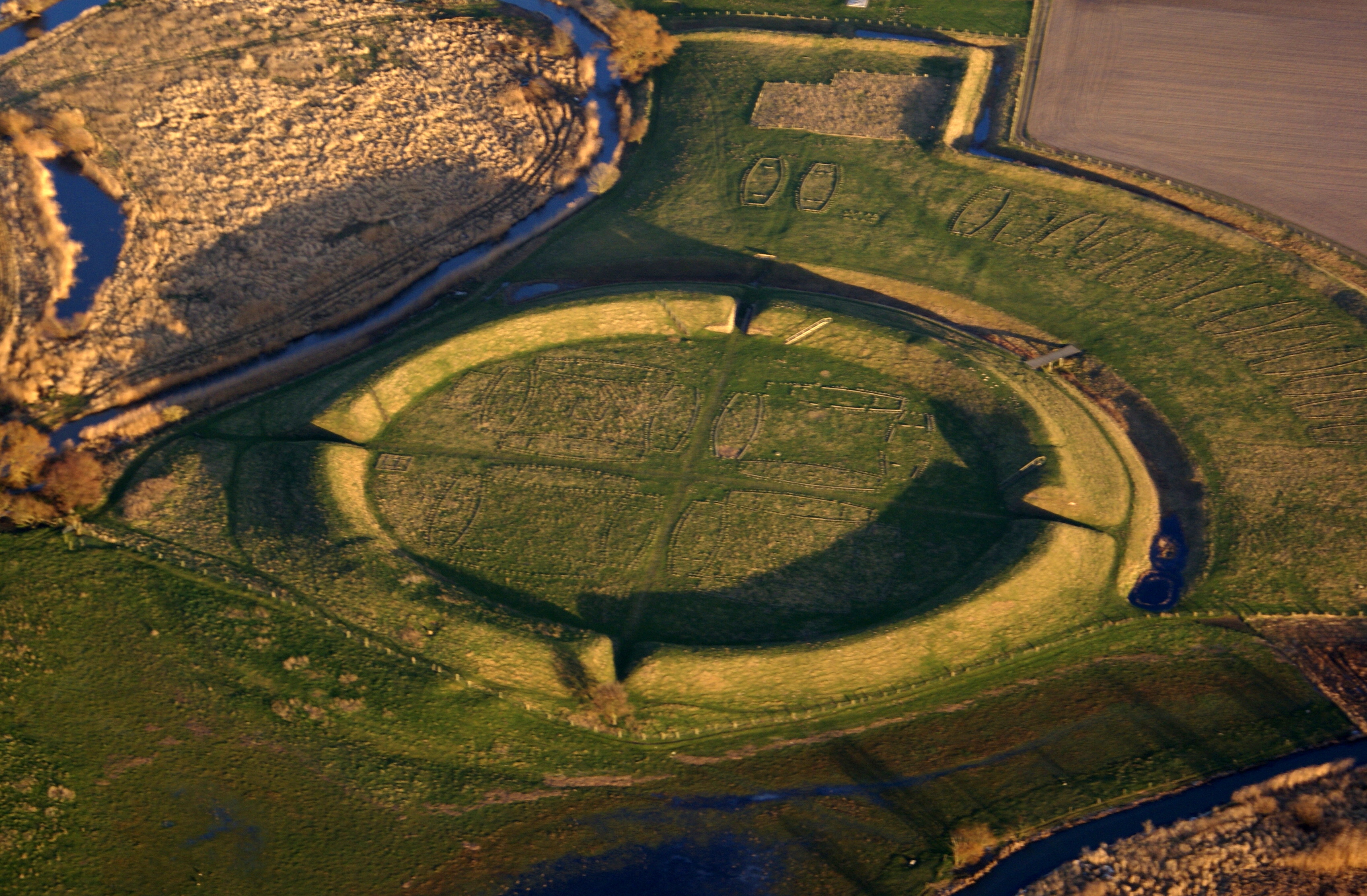
     There were six of the ring forts built in Denmark. They're all built on the same general layout. Here's an image of one of the actual ring fortresses and the image is courtesy of Wikipedia.


     Around the outside ring there was a ditch that was filled with sharpened stakes. Your only entrance would have been through those notches in the big dirt mound ring. Around the top of the dirt mound was a road. It would have been difficult to gain entrance if you were an invading army. You also didn't have much of chance if you were in the local populace and you tried to overthrow those who were your overlords. Yes, Christianity was forcibly introduced at that time. Many liked their old gods and didn't want the new one. I guess I can understand that.
     If you look at it from above you of course notice a general cross shape. It also crossed my mind that the four openings could also represent the four cardinal directions. Each of those were ruled by gods in Norse mythology. Therefore Christianity might be more easily accepted by the local Danes was what I was thinking. I may be a bit off there but I would like to see further studies done on the concept.

Friday, August 29, 2014

Research

It's interesting when you're doing research for a story. Sometimes you run across things like this. https://www.youtube.com/watch?v=qvGWM3Lw5RA

Now do I think Ivar was someone who had brittle bone disease? I don't know. While it is plausible I doubt it. Nonetheless I felt the documentary held some rather interesting concepts as to why he was nicknamed "the boneless." Personally I like the one where he probably had gigantism.

Monday, August 25, 2014

Viking Sun Compass

    One of the things I came across in my research of how the Vikings went from place to place are sun compasses. Apparently a couple of examples were found in some of the archaeological digs. Here's an image from one of the documentaries I was watching.

     I had to try and create one to test out the concept. I selected a small piece of plywood and attached screw in the middle. For the marks I'm just using a sharpie marker. Where I have it at so that I can get to it easily is on my porch railing.

     Here's after a few hours. While I'm not trying to mark it very precisely I'm able to get what north is in general. Where the red line is the closest to the screw would be the place it intersects with the north south axis. You'd simply draw a long line from that place through the screw. From then on you'd have a compass of a sort to use. You'd also have to make them several times per year depending on how long your voyages happened to take.
     Quite a fascinating bit of technology and history.

Friday, August 22, 2014

Long Boat

     This is what I've started working on. Parts of the story are loosely based upon the Viking sagas. I've been interested in it for a long time. Leif Erickson, and his father, Erick the Red will be central to parts of my story line just as they are in the Vinland and Greenland sagas. Because some of the sagas don't cover the timeline in depth I'm having to fill in bits here and there just like everyone that's written stories surrounding the sagas. Then again, I think the writers of the sagas filled in a bit here and there. 
     Of course, the sagas were written down about two or three hundred years after the events they were writing about and they consist of what had been spoken tales. There's a good chance that things were added to make for exciting campfire tales. Regardless, there's still a kernel of what really happened.
     Where I'm trying to be totally accurate is the actual historical archaeological evidence from the time. As a result I've been heavily studying Norse shipbuilding techniques and how they built their homes. So far I've learned a lot. I'm not sure I would want to hoist one of those felt sails for one. It would be kind of neat to actually do some of the carpentry though, it was amazing what they could do with hand drills, planes, axes, and draw knives.
     It's been many years since I first heard about L'Anse aux Meadows and the short term settlement that was there. Since then it's been proven it actually was a Norse settlement. I believe when I was reading through the sagas where the place is actually mentioned. Based on, both the sagas, and the archaeological dig it was never permanently settled. After reading a bit through the sagas I do understand why it would be short. Leif, and company, didn't treat the natives very well. I'm sure I would have been a bit upset too. Still, it's fun exploring it a bit.

Wednesday, August 20, 2014

Added a window.

     If you remember about a week ago I built a new back door. The idea was that I wanted greater energy efficiency long term. In this image you can see the old door underneath the bedroom window. You can also see the new door installed. It works really well but there was one detraction. If someone was knocking on it you had to open the door to see who was there. I write things like that where the person you don't want to meet is on the other side.
     I'll note that on the old door you could see frost that had collected on the inside during the winter. If you're seeing frost built up it's not a good thing. If cold is coming in you also have heat going out. A simple concept to understand from physics is that no matter what the surface is the temperatures will try to equalize on both sides of a surface. It kind of transfers. They'll try to become the same temperature and so heat will transfer to a cold area and vice verse. Why you insulate is to eliminate the transference if at all possible. Usually you're eliminating air movement.
     Now so care is required for window placement. It's not like I want someone smashing out the new glass and reach the door locks. Sorry, that's not secure. It required some thought on where I would place the new window as a result. Very quickly I decided double glazed was the only way to go. Roughly double glazed windows are four time more efficient that single glazed windows are. For one, you one have two panes of glass, second you have an air space that doesn't move.

     It took a lot of thought to create something that would work well for the intended purpose. That's one of  the reasons why my writing came to an end for the time being though I am researching for a project that centers around the Vikings in Newfoundland. One of the things I was thinking about is someone taking a hammer and smashing out the glass, reach in open the lock. Somehow that doesn't work for me. Of course, I write nutballs that would do such a thing and come into your house to kill you. Yes, that's the kind of nightmares I have to tell you the truth.
     I priced around new energy efficient windows. They are around $300 each which is not in the budget. Since that's extremely expensive so I started to look for a different solution. After much thought I finally came up with what seemed to be perfect There was a window in the old door. The mechanism no longer worked for opening the window, and honestly, it wasn't very energy efficient. Each of the panes was about 6 inches by 15 inches. That's a good size I felt. Here the panes are drying after their first bath. It was a literal pain to get them out of the aluminum framework. 
     The screws at the corners didn't want to loosen up. Then again the original window was over 40 years old. Finally I succeeded and got the panes out of the aluminum framework.

     Here I was testing out some various methods of spacers. There were a lot that were ejected rather quickly. Using some of the left over 1/8" plywood was one of them.

     With the glass ready for use I had to have a new frame to hold it in place. Of course with the requirements I had you need a spacer of some kind. It's not important if the spacer is all that precision made. It just needs to be about the same for the length. Sealer will make up the difference. There is also the fact it doesn't expand or contract all that much with temperature. 

Here's the framework put together and has begun to dry. The pieces of wood for the frame were reused when I cut the door to size. I figured they were already the right thickness.

     Here I've assembled the glass panes. The sealant hasn't dried yet.

     I've installed the window here. It will take a day or so for the window to dry effectively before I add the molding. 

     If all goes well I'll have the most energy efficient home built back door window as you can get. I really don't want to pay to heat up the exterior of the house. For further ideas you can get a copy of my Offsets and Savings book. It's available in many of the major e-book stores.